Mobile Signal
Why Is Mobile Signal Weak Inside Malls in Karachi? Causes & Solutions
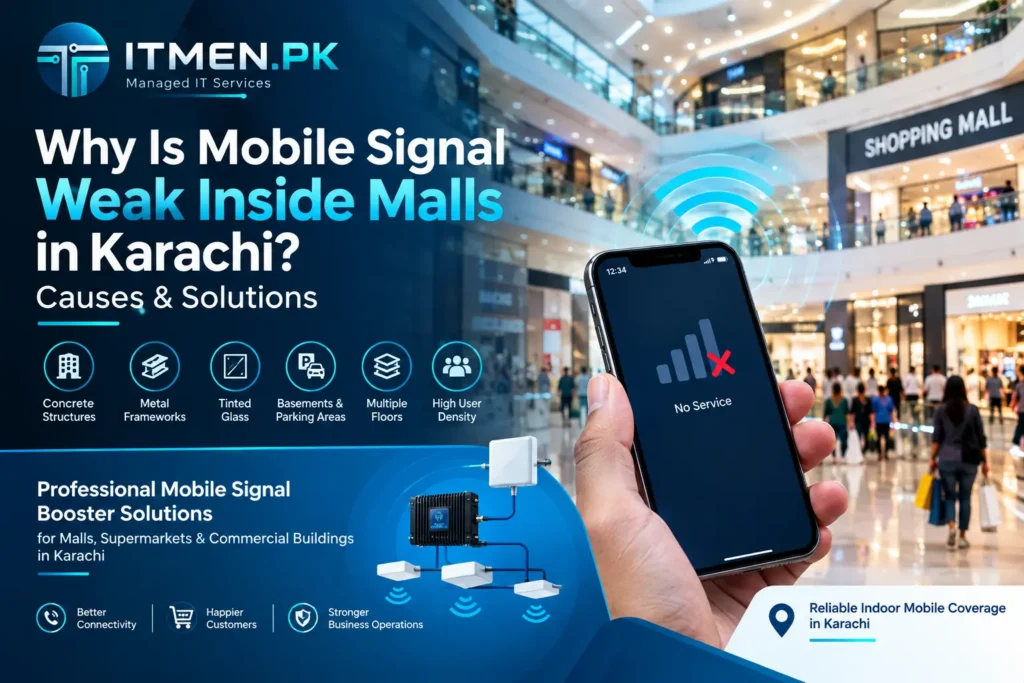
Walking into a shopping mall or large supermarket in Karachi can sometimes mean losing mobile signal almost immediately.
You may have full signal bars outside the building, but once you enter the basement, parking area, lower floor, or a section surrounded by concrete and metal structures, your phone may show only one or two bars—or no usable mobile service at all.
This can be frustrating for shoppers, but it can become a much bigger problem for businesses operating inside large commercial buildings.
Customers need mobile connectivity for calls, messaging, mobile applications, online payments, ride-hailing, digital wallets, and browsing product information. Employees and management teams may also depend on mobile communication throughout the building.
Large retail environments such as supermarkets and shopping centres can therefore benefit from properly planned indoor mobile coverage.
Why Is Mobile Signal Weak Inside Malls and Supermarkets in Karachi?
Weak indoor mobile signal does not always mean that the mobile network itself is unavailable in the area.
In many cases, the problem is caused by the building.
A mobile signal that is strong enough outside may become significantly weaker after passing through multiple layers of building materials and internal structures.
Several factors can contribute to poor indoor coverage.
1. Thick Concrete Walls and Floors
Large commercial buildings often use reinforced concrete walls, floors, pillars, and ceilings.
These structures can reduce the strength of radio signals entering the building. The effect can become more noticeable in basements and lower levels where there may be little direct exposure to an outdoor cellular signal.
This is one reason why a phone may work normally near the entrance but struggle further inside the building.
2. Metal Structures Can Block or Reduce Signal
Shopping malls and supermarkets contain substantial amounts of metal.
Structural frameworks, metal shelving, elevators, equipment, doors, ceilings, and other building components can interfere with the propagation of cellular signals.
Large supermarkets can be particularly challenging because extensive shelving and equipment can create additional physical obstacles between the outside signal and indoor users.
3. Tinted and Specialized Glass
Modern commercial buildings frequently use glass for entrances, windows, façades, and internal areas.
Some types of coated or treated glass can reduce radio-frequency signal penetration.
This means that being surrounded by large glass surfaces does not necessarily guarantee good mobile reception.
4. Underground Parking and Basements
Basements are among the most common mobile dead zones in commercial properties.
Underground parking areas are surrounded by concrete, earth, structural materials, and other obstacles that can make it difficult for an outdoor cellular signal to reach users below ground.
As a result, customers may find that their phones work perfectly outside but lose service after entering an underground parking area.
5. Multi-Floor Building Design
A shopping mall may have several floors, parking levels, retail areas, food courts, offices, storage areas, and service corridors.
Mobile coverage may therefore vary considerably from one section to another.
One floor may have acceptable coverage while another floor has weak or inconsistent service.
6. Distance From the Outdoor Signal
Mobile networks are designed around outdoor coverage from cellular base stations.
The signal available at the exterior of a building may not be equally strong throughout its interior.
The further the signal has to travel through building materials, the greater the potential for indoor coverage problems.
7. Network Congestion
Signal strength and network capacity are not exactly the same thing.
A phone can show reasonable signal bars while the mobile internet remains slow because many users are connected to the network at the same time.
Shopping malls can experience very high concentrations of mobile users during weekends, public holidays, promotions, and special events.
For this reason, a proper assessment should consider both signal strength and actual network performance.
What Does Weak Mobile Signal Look Like Inside a Mall?
A mobile signal problem can appear in several different ways.
Common signs include:
- Calls dropping inside specific areas
- Difficulty making or receiving calls
- Mobile internet becoming extremely slow
- 4G/LTE changing to a weaker connection
- Messages taking longer to send
- Mobile applications failing to load
- Customers moving toward entrances or windows to make calls
- Poor coverage in basements
- Different signal levels on different floors
- Employees having to leave the building to make important calls
Sometimes the problem is obvious because a phone shows zero bars.
In other cases, the phone appears connected but the service is unreliable.
That is why a proper site assessment is more useful than simply looking at the signal indicator on a phone.
How Weak Mobile Signal Can Affect Supermarkets and Shopping Malls
For a customer, poor mobile coverage is an inconvenience.
For a large retail business, it can affect the overall customer experience.
People increasingly use smartphones while shopping.
They may need mobile connectivity to:
- Contact family members
- Use mobile banking
- Access digital wallets
- Compare products and prices
- Use shopping applications
- Contact ride-hailing services
- Receive verification codes
- Communicate with staff
- Access online information
Employees may also depend on mobile communication for day-to-day coordination.
Mall management, security teams, maintenance staff, retailers, delivery personnel, and other employees may need reliable communication across different sections of a large building.
For businesses operating inside a mall or supermarket, connectivity should therefore be considered part of the overall infrastructure.
Imtiaz Supermarket and Indoor Mobile Signal Problems
Large supermarket environments provide a useful example of why indoor mobile coverage can become challenging.
Imtiaz Supermarket – Clifton – KHI is a large retail environment in Karachi, where customers can encounter the typical connectivity challenges associated with enclosed commercial spaces.
There are also public reports of mobile-signal difficulties at an Imtiaz location, particularly in a basement area where users reported that mobile network signals were almost nonexistent. This illustrates the type of indoor coverage problem that can occur when a large retail space combines underground areas, concrete construction, and limited outdoor signal penetration.
The important point is that an indoor mobile signal problem should be assessed at the individual building level.
The solution for one supermarket may not be identical to the solution for another.
Mala Supermarket and Indoor Coverage Challenges
Mala Supermarket in Gulzar-e-Hijri, Karachi, is another example of a large retail environment where indoor connectivity can become an important consideration.
For supermarkets and commercial properties, the goal should not simply be to install a signal amplifier and hope for better coverage.
The building should first be assessed to determine:
- Existing outdoor signal strength
- Available network operators
- Indoor dead zones
- Building size
- Number of floors
- Basement coverage
- Required coverage area
- Antenna locations
- Cable routing requirements
This assessment helps determine whether a signal booster is appropriate and how the system should be designed.
How Can You Improve Mobile Signal Inside a Mall?
There is no single solution that works for every commercial building.
The first step is to understand the existing signal environment.
Step 1: Test the Signal Outside
The outdoor signal should be measured around the building.
This helps determine whether a usable cellular signal is available to capture and distribute indoors.
Step 2: Identify Indoor Dead Zones
The building should be surveyed to locate areas where the signal becomes weak or unusable.
These may include:
- Basement parking
- Lower floors
- Back sections of supermarkets
- Storage areas
- Food courts
- Retail corridors
- Internal offices
- Service areas
Step 3: Test Different Networks
A commercial building may have users on different networks.
In Pakistan, customers and employees may use Jazz, Zong, Telenor, or Ufone.
A professional assessment should therefore consider the networks that need coverage.
Step 4: Determine the Required Coverage Area
A small retail shop and a multi-floor shopping mall have completely different requirements.
The system may need a single indoor antenna for a smaller space or multiple antennas for a larger commercial building.
Step 5: Design the Appropriate Solution
Once the building has been assessed, the appropriate equipment, antenna positions, cabling, and coverage strategy can be determined.
Can a Mobile Signal Booster Improve Coverage Inside a Mall?
Yes, a properly designed and approved mobile signal booster system can help improve indoor mobile coverage when a usable external signal is available.
A typical system consists of three main components:
Outdoor Antenna → Signal Amplifier → Indoor Antenna(s)
Outdoor Antenna
The outdoor antenna is positioned where the best available mobile signal can be captured.
This is often installed on a rooftop or suitable exterior location.
Signal Amplifier
The amplifier strengthens the captured signal and distributes it through the indoor system.
Indoor Antennas
Indoor antennas distribute the improved signal throughout the required coverage area.
Larger commercial properties may require multiple indoor antennas to provide more consistent coverage.
However, a booster cannot create a mobile signal where there is absolutely no usable signal available outside the building.
That is why a professional site assessment is important before selecting equipment.
Mobile Signal Booster Installation for Shopping Malls in Karachi
I.T Men provides professional mobile signal booster installation in Karachi for commercial and business environments.
The service is designed for properties experiencing problems such as:
- Weak indoor mobile signal
- Dropped calls
- Mobile internet problems
- Basement dead zones
- Multi-floor coverage problems
- Warehouse coverage gaps
- Retail and shopping-plaza connectivity issues
I.T Men states that its signal booster service supports PTA-approved 3G, 4G and 5G equipment for Jazz, Zong, Telenor and Ufone, with site assessment, professional installation, testing, and support.
For a mall or supermarket, the installation process should be based on the actual structure and coverage requirements rather than simply selecting the most powerful-looking device.
Learn more about Mobile Signal Booster Installation in Karachi
How Professional Installation Works
A commercial signal booster installation generally follows several stages.
1. Site Assessment
The first step is to inspect the building and measure the available outdoor signal.
The engineer can identify where the signal is strongest and where indoor dead zones are located.
2. Coverage Planning
The required coverage area is mapped according to the building layout.
This helps determine antenna positions and cable routes.
3. System Design
The appropriate booster, outdoor antenna, indoor antennas, cables, and supporting equipment can then be selected.
4. Professional Installation
The equipment is installed with appropriate antenna positioning and cable routing.
For commercial properties, neat and secure installation is particularly important because the system should not interfere with normal retail operations.
5. Testing
Coverage should be tested after installation to determine whether the targeted areas have improved.
I.T Men states that its process includes before-and-after signal readings and testing across supported networks.
6. Handover and Support
The final stage includes documentation, warranty information, and ongoing support where applicable.
Why Professional Signal Booster Installation Matters
Buying a signal booster is not necessarily the same as solving a building-wide coverage problem.
Commercial properties can have complex layouts.
A poorly positioned outdoor antenna, unsuitable equipment, incorrect cabling, or insufficient indoor antenna coverage can result in poor performance.
Professional installation helps address these factors before the system is deployed.
For large supermarkets and malls, this becomes even more important because the required coverage area can be extensive.
The objective should be consistent and properly planned indoor coverage, not simply a higher signal reading in one location.
Does a Signal Booster Work for Basement Parking?
A basement can often be one of the best use cases for a properly designed signal booster system.
If a usable outdoor signal is available, an outdoor antenna can capture that signal and distribute it through an indoor antenna system inside the basement.
This can help address dead zones in:
- Underground parking
- Basement retail areas
- Basement offices
- Storage areas
- Commercial service areas
However, the building should be assessed first because basement construction, depth, size, and available external signal can vary significantly.
What About Multi-Storey Shopping Malls?
Multi-storey buildings require more careful planning.
A single indoor antenna may not provide sufficient coverage across multiple floors.
Depending on the building, a system may use several indoor antennas connected through an appropriately designed distribution network.
The design should consider:
- Floor area
- Number of floors
- Wall thickness
- Building materials
- Outdoor signal strength
- Required networks
- Antenna placement
- Cable length
- Areas requiring priority coverage
This is why commercial signal booster installations should be treated as an infrastructure project rather than a simple plug-and-play device installation.
Choosing a Signal Booster for a Mall or Supermarket
Before selecting a solution, property owners and facility managers should ask:
Is there usable mobile signal outside the building?
If the answer is yes, a booster may be an appropriate solution for improving indoor coverage.
You should also determine:
- Which mobile networks need to be supported?
- How large is the building?
- How many floors need coverage?
- Are there basement areas?
- Where are the dead zones?
- How many users are expected?
- Does the building require discreet installation?
- Where can antennas and cables be installed?
These questions help prevent purchasing equipment that is unsuitable for the building.
Mobile Connectivity Is Part of the Customer Experience
Shopping behaviour has changed.
Customers do not simply enter a supermarket, purchase products, and leave.
They use smartphones throughout the shopping journey.
They may check prices, communicate with family members, use mobile banking, access loyalty applications, arrange transportation, contact businesses, and browse product information.
When mobile connectivity disappears inside a commercial property, the customer experience can suffer.
For large supermarkets and shopping malls, reliable indoor connectivity can therefore become an important part of the overall digital environment.
When Should a Mall Consider a Mobile Signal Booster?
A professional assessment may be worthwhile if a commercial property experiences:
- Persistent indoor dead zones
- Poor basement coverage
- Dropped calls
- Weak mobile internet
- Different signal levels across floors
- Customers complaining about connectivity
- Employees leaving the building to make calls
- Poor coverage despite good outdoor signal
- Connectivity problems affecting specific areas
If the outdoor signal is usable but indoor coverage is significantly weaker, a properly designed indoor signal solution may be worth considering.
Frequently Asked Questions
Why is my mobile signal strong outside a mall but weak inside?
The building itself can reduce cellular signal strength. Concrete, metal structures, glass, multiple floors, elevators, basement areas, and other construction elements can make it difficult for outdoor signals to penetrate throughout the building.
Why is mobile signal especially weak in mall basements?
Basements are surrounded by concrete and earth and are located below ground level. This can significantly reduce the amount of cellular signal reaching the area from outside.
Can a mobile signal booster work inside a supermarket?
Yes, a properly designed booster system can improve indoor mobile coverage when a usable external signal is available. The required equipment and antenna arrangement depend on the supermarket’s size, construction, and coverage requirements.
Can one signal booster support multiple mobile networks?
Some approved multi-operator systems can support multiple networks. I.T Men states that its PTA-approved multi-network booster solutions support Jazz, Zong, Telenor and Ufone.
Will a signal booster work if there is no signal outside?
A booster needs a usable external signal to capture and redistribute. If there is effectively no cellular signal available outside the building, a conventional booster cannot simply create a cellular network from nothing.
Can a signal booster cover a multi-floor mall?
It can, depending on the building and system design. Multi-floor properties may require multiple indoor antennas and a carefully planned distribution system.
Can a signal booster improve basement parking coverage?
Yes, basement parking can often benefit from a professionally designed system when an adequate outdoor signal is available for the external antenna.
How much does mobile signal booster installation cost in Karachi?
There is no single price for every commercial property. Cost depends on building size, number of floors, signal strength, required coverage, antenna quantity, cabling, and installation complexity. A site assessment allows the required system to be determined more accurately.
Is professional installation necessary?
For a small environment, equipment requirements may be relatively straightforward. However, malls, supermarkets, basements, warehouses, and multi-storey buildings can require detailed signal testing, antenna planning, cabling, and post-installation verification. Professional installation is therefore recommended for commercial projects.
Does I.T Men provide mobile signal booster installation in Karachi?
Yes. I.T Men provides mobile signal booster installation services in Karachi and lists solutions for offices, basements, warehouses, retail and shopping plazas, healthcare facilities, and multi-storey buildings.
Improve Mobile Signal Coverage in Your Commercial Property
Weak mobile signal inside a mall or supermarket is not always caused by the mobile operator.
In many cases, the building itself creates the coverage problem.
Concrete structures, metal, glass, multiple floors, underground parking, and internal layouts can prevent outdoor cellular signals from reaching customers and employees effectively.
The right approach is to first assess the available signal, identify the dead zones, understand the building layout, and then design an appropriate indoor coverage solution.
If your mall, supermarket, office building, basement, warehouse, or commercial property in Karachi is experiencing weak mobile coverage, I.T Men can assess the environment and recommend a suitable signal booster solution.
Book a site assessment with I.T Men to identify your indoor mobile coverage problems and explore a professionally designed solution.
I.T Men — Business IT Networking & Connectivity Solutions in Karachi
Phone: +92 317 1148636
Office: Office No. 3A/1, 3rd Floor 1/6-Q, Panasonic Centre, Block 06, P.E.C.H.S., Karachi 75350